
Blog
Entryway Flooring for GTA Winters: What to Choose Before the Snow Arrives


Short answer: For a front entry or mudroom that receives wet boots, start by comparing floor-rated porcelain tile with vinyl plank approved for that use. Keep laminate and wood in the comparison for drier halls, but check the exact product’s water-exposure limits. Your choice should account for wet-foot traction, the subfloor, door clearance and the transition into the next room.
In a Vaughan or GTA home, the garage door may bring in more winter mess than the front door. Before you choose a colour, look at where your family takes off boots and where meltwater collects. A small, well-planned entry zone can protect the flooring beyond it without forcing you to replace the whole main floor.
Choose for the doorway you use, not just the room name
A sheltered hallway and a busy garage entrance need different plans. For a dry interior hall, you might prioritize matching the adjoining floor. For an entrance where children leave snowy boots, give water management and cleaning more weight.
- Direct outdoor entrance: Plan space for an absorbent mat and a boot tray, then choose a floor with documented suitability for the expected exposure.
- Garage-to-house mudroom: Check the boot-removal area, storage layout and door swing before ordering material.
- Interior hallway: Compare appearance and transitions with the adjacent rooms, while keeping wet footwear off the floor.
- Unheated vestibule: Ask about the product’s operating-temperature limits. Do not assume an indoor floor suits an unheated space.
Porcelain, vinyl, laminate or hardwood: a practical comparison
| Flooring | Where to consider it | Confirm before buying |
|---|---|---|
| Porcelain tile | A defined entrance or mudroom where you expect wet footwear | Floor-use approval, wet-use suitability, surface traction, grout and subfloor preparation |
| Vinyl plank | An entry that connects to a wood-look main floor | Water-exposure warranty, temperature range, locking or adhesive requirements and approved mats |
| Laminate | A drier hall, or an entry where the selected product permits the expected exposure | Spill-cleanup time, perimeter details and the exact water-resistance warranty |
| Engineered or solid hardwood | A protected, dry hall where you want real wood continuity | Moisture-care instructions, indoor conditions and protection at the exterior door |
For porcelain tile, check more than “matte” or “polished”
Browse our porcelain tile collection, then ask for the selected tile’s technical information. A finish label or a photograph does not establish how a tile performs under wet footwear.
Daltile’s slip-resistance guidance explains that dynamic coefficient of friction, or DCOF, helps compare surfaces under controlled test conditions. It also cautions that the test cannot tell you whether a slip will occur. Ask your installer to assess the product, expected contaminants and maintenance together. No floor is slip-proof.
Check the layout at the same time. A narrow entry can leave awkward slivers beside a door frame. Draw the room, mark the threshold and closet openings, and review cuts before committing to a tile size. Our 12×24 versus 24×24 tile guide covers that separate size decision.
For vinyl and laminate, read the water warranty
If you want the entrance to blend into the living area, compare vinyl plank flooring and laminate flooring using the instructions for each product. “Waterproof” on a sample does not explain the entire installation. Ask how the manufacturer treats standing water, seams, room perimeters and moisture below the floor.
For laminate, confirm whether the warranty covers the exposure you expect and how soon you must remove spills. For vinyl, check the mat backing as well as the floor itself. Shaw’s vinyl care guidance, for example, recommends entrance mats without latex or rubber backing to reduce possible discolouration. Follow the instructions for the floor you buy rather than assuming that one manufacturer’s guidance applies to every product.
Plan the boot area before the installation
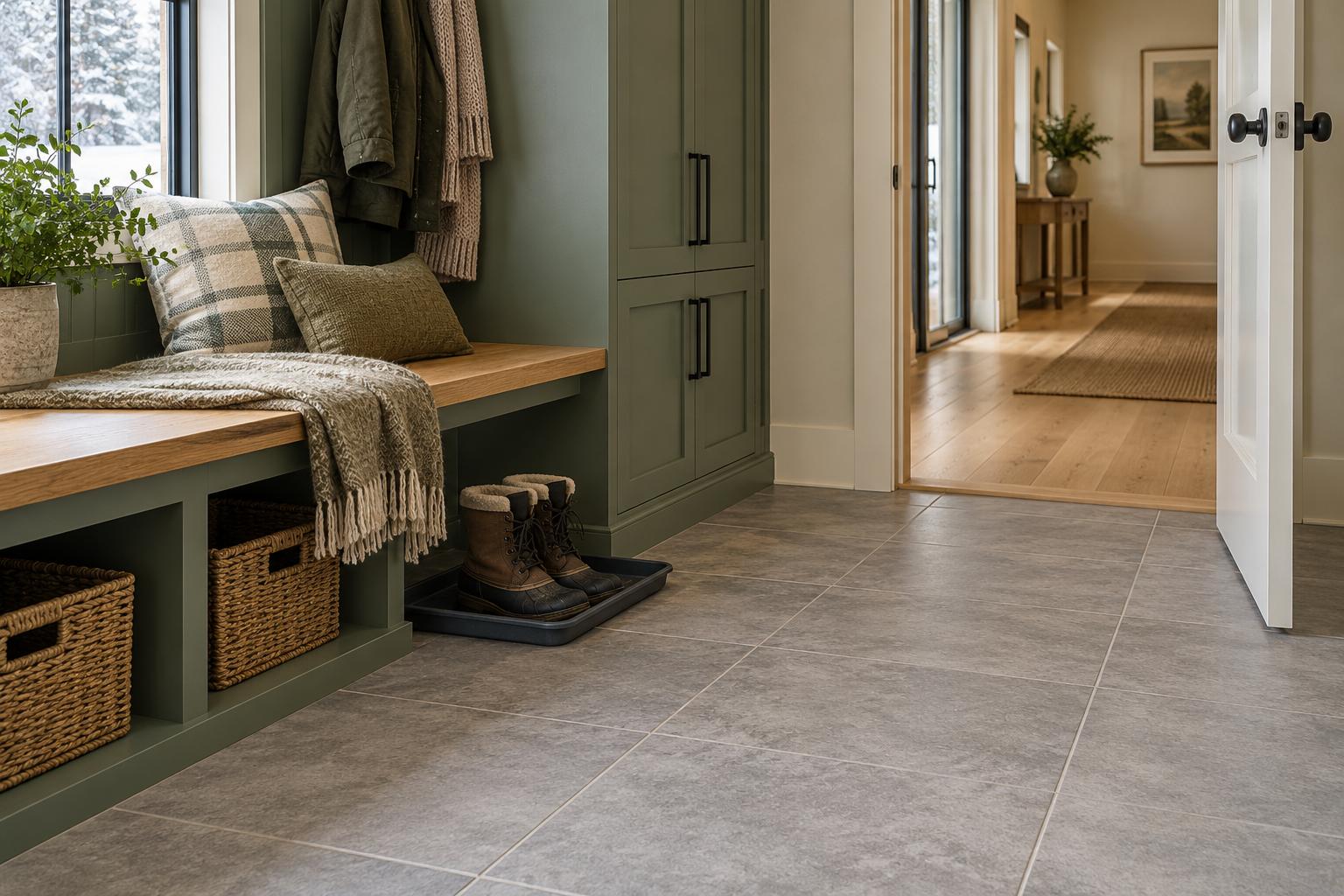
Measure the mat and tray you intend to use. Open the door over them. Make sure you can reach the closet without stepping across a wet patch. These small checks matter as much as choosing between two similar floor colours.
- Remove loose grit first. Sweep or vacuum using the floor manufacturer’s approved hard-surface setting before damp cleaning.
- Wipe up meltwater. Empty the tray and dry underneath it. Check beneath mats rather than leaving trapped moisture in place.
- Use an approved cleaner. Follow the floor and grout instructions, including dilution and drying. Avoid improvised salt-removal mixtures unless the manufacturer permits them.
- Keep mats clean. A saturated or grit-filled mat needs attention too.
Keep the design current without choosing by trend alone
MSI’s 2026 design report highlights warm wood tones, creamy stone looks and textured surfaces. For an entry, you can use that direction through a warm neutral tile or a wood-look floor that complements adjoining rooms. Compare samples beside your existing floor in daylight and under your evening lights. A fashionable colour still needs the right use rating and care plan.
Include the threshold and subfloor in your quote
Ask the installer to review subfloor condition, finished floor height and the junction with the adjoining room. Check exterior-door clearance, closet doors and any stair connection before work begins. For tile, discuss preparation and the installation assembly. For floating floors, confirm expansion space and how the installer will handle fixed cabinetry and transitions.
Our installation calculator can help you explore a starting budget. A small entrance needs a project-specific quote: preparation, cuts, transitions and minimum job charges may not scale down in proportion to the room’s square footage. See our porcelain tile installation service for the next step.
Entryway flooring FAQ
Is matte tile enough to make an entry safe when wet?
No. Check the manufacturer’s intended-use information and slip-resistance data for the exact tile. Keep the entrance dry and clean; a matte finish does not guarantee traction.
Can I keep hardwood in my front hall?
You can retain wood in a protected hall if you follow its care requirements. Keep snowy boots in a tray, use a compatible mat and remove water without delay. If the entrance stays wet, discuss a separate tile or approved vinyl zone with your installer.
Can I install the same floor in an unheated porch?
Only if the manufacturer approves the temperature range and site conditions. Ask about the floor, adhesive or locking system, and subfloor as a complete installation.
Should the entry flooring match the living room?
It can coordinate rather than match. Bring both samples together and plan the transition location and finished heights. Choose the entry material for the exposure it will receive.
Bring your entryway plan to our Vaughan showroom
Bring a doorway photo, room measurements and a sample or photo of the adjoining floor to Home Design Flooring at 8001 Jane Street, Vaughan. Tell us which door receives the wet boots. We can help you compare options and discuss installation for your GTA project. Contact our showroom to confirm current product availability, pricing and suitability before ordering.
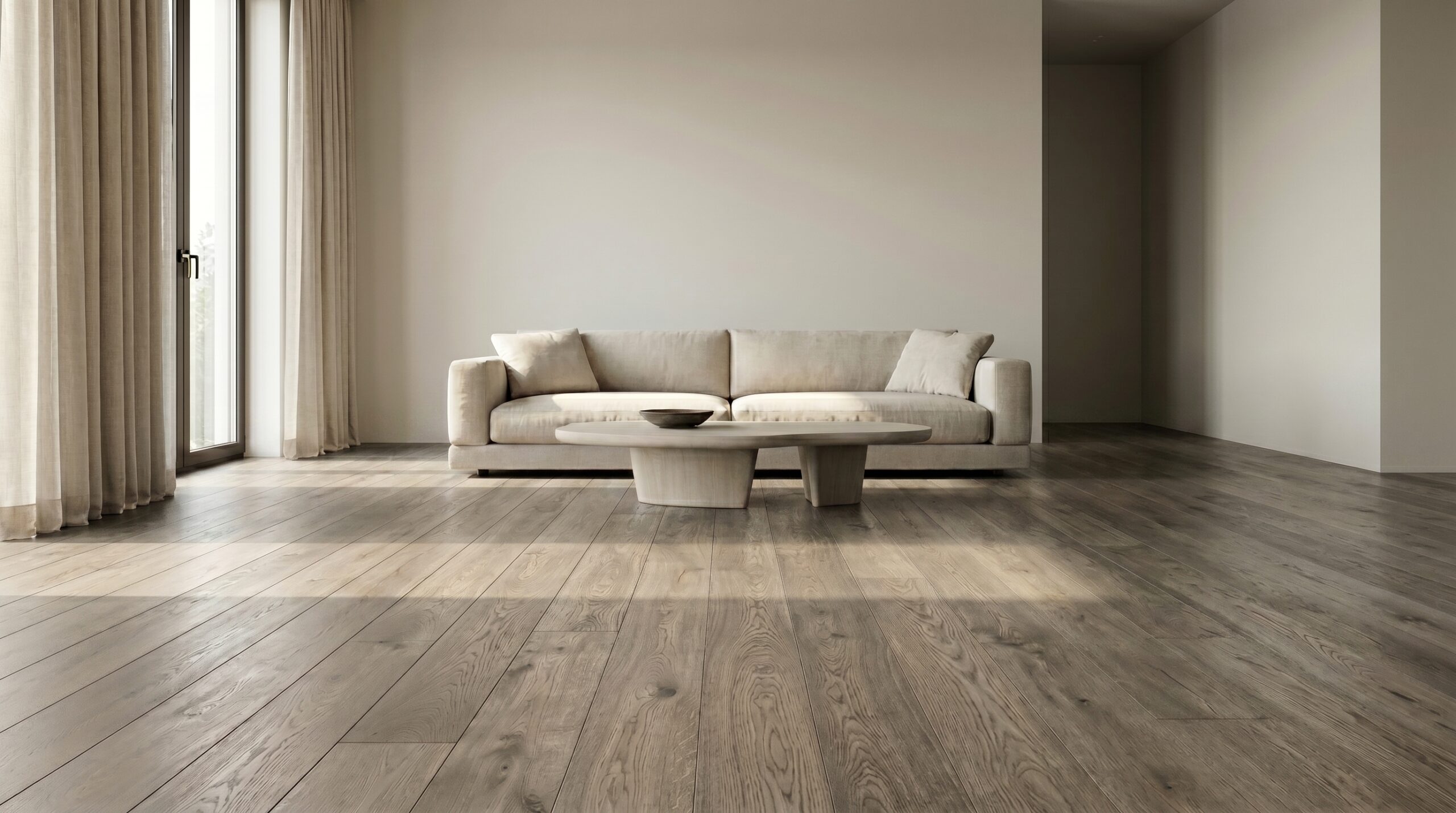
Reviewed October 19, 2026. Images are original AI-generated design concepts created for Home Design Flooring; they do not depict a completed customer installation or an exact product for sale.